Living Memory for Your Project
Practical tips for traceability, context indexing, templates, and governance—so decisions and constraints live where people and agents can actually find them.
Living Memory for Your Project
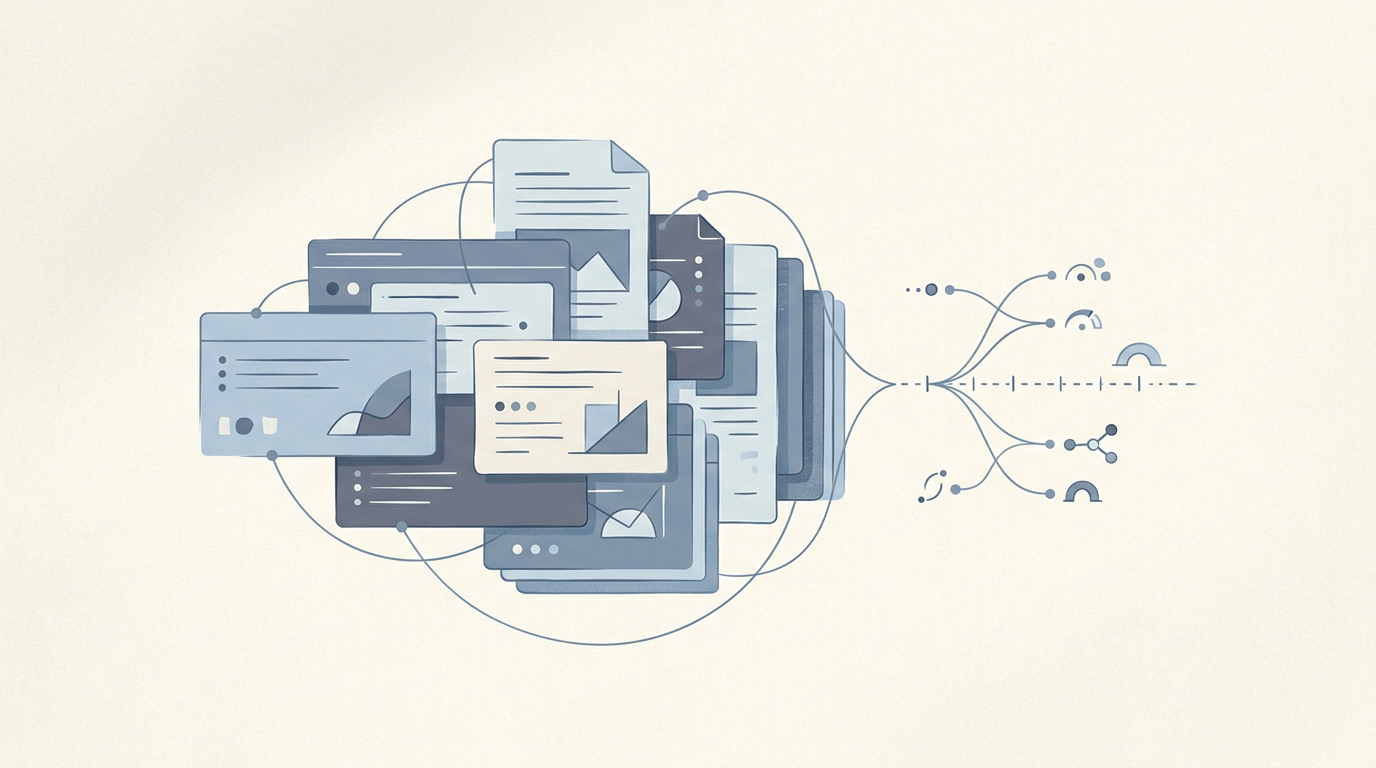
Living memory is not “more documentation.” It is versioned, navigable context that stays aligned with how work actually happens—so the next human, the next model, and the next quarter all start from the same ground truth.
The benefit is blunt: less re-discovery, fewer repeated mistakes, safer handoffs, and agents that retrieve signal instead of vibes. Below are patterns that pay off quickly.
Workflow traceability
Make it obvious how a change maps to intent—without turning the repo into a ticket dump.
Examples:
- Commit messages that reference an issue or decision ID (
feat(auth): session refresh (#1423)), sogit blametells a story. - A short “why” in the PR body: user impact, risk, rollback—not only the diff.
- ADRs (Architecture Decision Records) for forks in the road: one file per decision, immutable once accepted, superseded by a new ADR instead of silent edits.
- Release notes or a CHANGELOG that humans actually read—especially when behavior or contracts shift.
Benefit: When something breaks in production, you can answer what changed, for whom, and under what assumption—without archaeology in chat.
Context indexing
Indexing means telling people (and tools) what to read first and what is stale.
Examples:
- A root map:
READMEordocs/README.mdwith “start here,” “architecture,” “runbooks,” “product brief”—each link one hop away. - A context index file used by agents: a short ordered list—always read X before Y—so prompts don’t shovel the whole repo into the window.
- Front matter or status on heavy docs (
status: draft | current | superseded) so “official” vs “exploratory” is explicit. - Deprecations that point to the replacement doc, not a dead end.
Benefit: Onboarding and model runs converge on the same canon instead of everyone inventing their own partial picture. (See also Chat is a bad system of record—files you choose and index beat threads.)
Templates, rules, and repeatable structure
Templates lower the cost of doing the right thing; rules encode non-negotiables where the work happens.
Examples:
- PR template: testing notes, screenshots for UI, migration checklist for schema changes.
- Issue templates: repro steps, expected vs actual, environment—so triage isn’t guesswork.
- Editor or agent rules (e.g. Cursor rules): stack conventions, test commands, “never commit secrets,” folder boundaries—short, enforced, living next to the code.
- Scaffolding for new modules (folder layout, naming) so “the right place” is obvious.
Benefit: Quality becomes path-dependent in a good way—the easy path matches team standards, and reviews focus on substance, not re-negotiating basics every time.
Governance and policies
Governance is how you connect speed to risk, approvals, and auditability—especially when AI accelerates edits.
Examples:
- Branch protection, required review, and secrets scanning before merge.
- Explicit “human must approve” zones: payments, PII, production config, client-facing copy.
- Project mode or tiered policy: prototype vs production—same honesty, different strictness. (See Governance isn’t flavor text.)
Benefit: You keep velocity without turning the repository into an unowned shared drive—accountability stays visible.
Extras that compound
- Runbooks next to services: deploy, rollback, on-call—tested occasionally, not myth.
- Glossary or domain dictionary when the product language is dense—stops ambiguous “fix the thing” tasks.
- Periodic pruning: archive or merge docs so the index stays honest; living memory implies gardening.
For how to keep that infrastructure aligned over time—layered runtime, instruction sync, workflow validation, and an installable reference—see Maintained Context — The Toolkit Shows How (built around the Cursor Agentic Toolkit).
The insight: treat memory as infrastructure—indexed, traceable, governed—not as a pile of PDFs. The return is faster, safer work with humans and models, not in spite of them.