Maintained Context — The Toolkit Shows How
More detail on the Cursor Agentic Toolkit as living memory: indexed context, workflow chains, validation, layers—and how that maps to versioned, navigable ground truth.
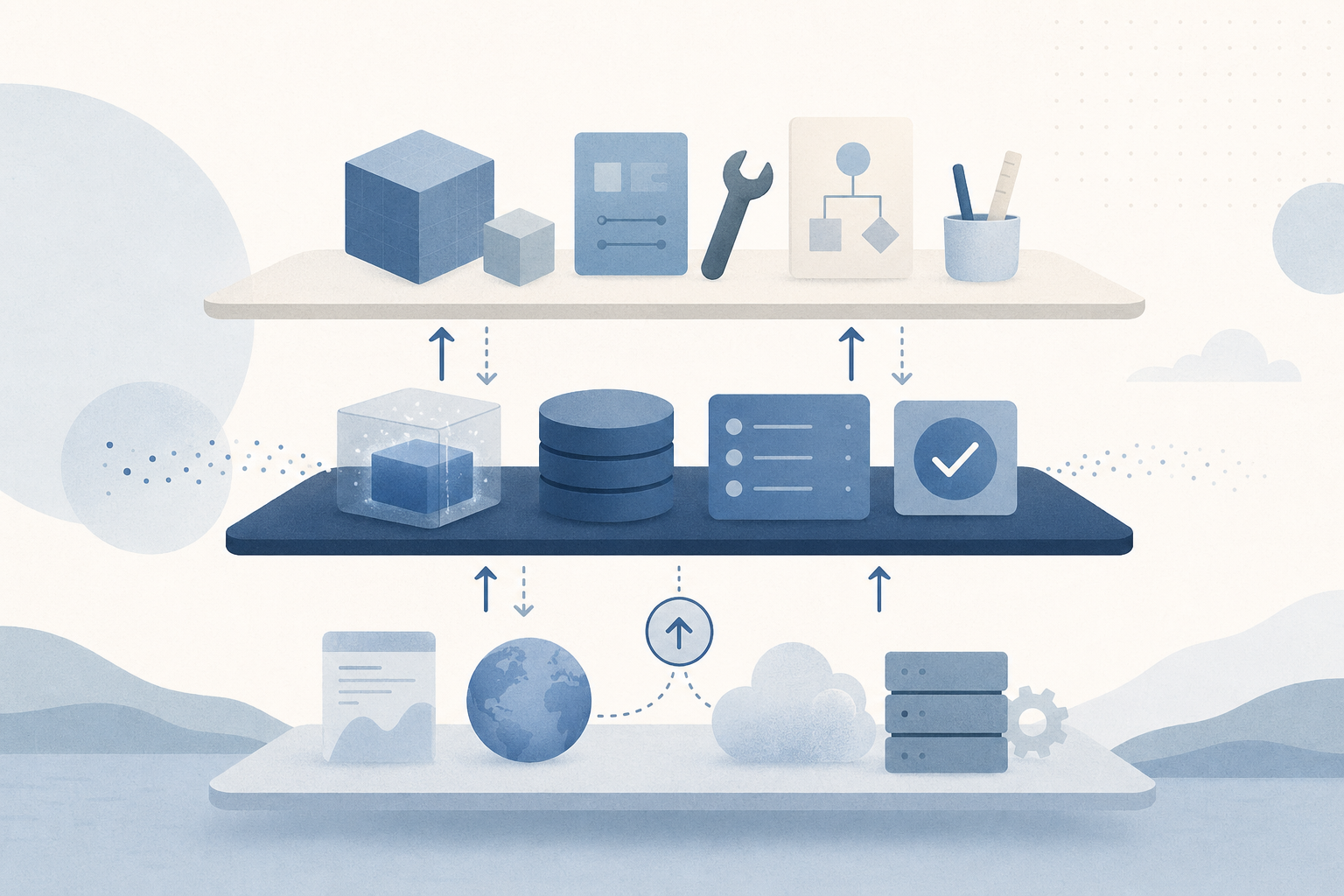
Maintained Context — The Toolkit Shows How
This is more detail on the toolkit behind Living memory for your project—how Cursor Agentic Toolkit lines up with that article in practice. For a shorter Lab intro to the repo, see Cursor Agentic Toolkit.
What “living memory” means here (one line)
Living memory is versioned, navigable context so the next person and the next model start from the same ground truth—not a pile of PDFs, but indexed, traceable, maintained information tied to how work is done.
The toolkit does that by splitting reusable “how we work” from per-project “what this product is,” then routing serious change through files that stay in git and rules that sit next to the code.
Smart context management (not “read the whole repo”)
Indexed entry points tell agents what to read first and in what order:
context-index.md— Catalog of context files with status (empty,template,current,stale) and links into workflow/onboarding docs—the control-plane version of always read X before Y so prompts do not need the entire tree.repo-map.md— Navigation: what lives where and how the runtime is arranged.- Typed context files — Split concerns (business, client, technical, constraints, package policy, governance) so retrieval is targeted, not one blob.
- External sources — Registered explicitly and summarized locally; the model follows pointer + summary + last validated, not tacit knowledge trapped in chat.
- Context health and a refresh schedule (e.g. after task packs) — The gardening the earlier article calls for: memory stays honest over time.
“Smart” here means curated, layered, status-aware, with a single index steering what gets loaded first.
How that becomes living memory in the repo
Versioned, in-repo truth — Team mode commits .agentic/ so briefs, specs, decisions, tasks, QA, and index updates live in git: the same versioned context as in the article, aligned with the product repo.
Traceable workflow (intent → code → proof) — The chain is explicit (intent → feature brief → spec → optional decision note → task pack → implementation → QA → doc/context update); see WORKFLOW_EXPLAINED.md in the toolkit. WORKFLOW_VALIDATION.md sets pass criteria per stage for agents and humans—so how a change maps to intent is required, not improvised after the fact.
Decision memory — Decision notes under .agentic/workflow/decisions/ capture options, the chosen path, and consequences—same job as ADRs in the earlier article: forks in the road as separate files, not silent edits scattered across docs.
Traceability the article also asks for — Governance encourages clear commits; PR expectations include traceability IDs (FB / SP / TP / QA-style hooks) and context consistency for non-trivial work. Toolkit source ships CHANGELOG.md; projects get nudged to keep behavior changes visible the same way.
Rules as enforced, living context — .cursor/rules/*.mdc encode non‑negotiables next to the work (workflow gates, QA logging, human tasks, governance)—the templates + rules pattern so the easy path is the right path.
Shared vocabulary — agentic/guide/GLOSSARY.md matches the article’s domain dictionary: terms like “task pack” and “runtime layer” mean the same thing for people and tools.
Governance and risk — governance.md and related rules cover git boundaries (e.g. agents not pushing by default), secrets / PII, and gates for high-risk change—speed with accountability, as in the article’s governance section.
Human-in-the-loop you can see — Human work is not only a policy table: the toolkit expects real human-tasks/pending/*.md files for things only a person can do, so accountability and handoff live in the repo, not only in threads.
Copilot + Cursor alignment — AI_INSTRUCTIONS_SYNC.md and the Copilot instructions source keep two agent surfaces on the same written policy—so memory is not “whatever Cursor said last session.”
The layered model (why it scales)
| Layer | Role in living memory |
|---|---|
Toolkit source (agentic/ in the toolkit repo) | Reusable patterns, templates, rules, guides—the methodology. |
Project runtime (.agentic/ in a real project) | Committed operational memory: context summaries, workflow artifacts, indexes. |
project-ops (optional symlink) | Longer or sensitive material outside the app repo, still linked and summarized in indexed context. |
Memory behaves like infrastructure: you can respect public-repo constraints while keeping operational depth—without losing one navigable index.
Bottom line
Living memory for your project argues for traceability, a context index with fresh/stale signals, repeatable structure (templates + editor/agent rules), governance, and periodic pruning. The Cursor Agentic Toolkit implements that on purpose: context index + repo map + status fields, a chained workflow with ID’d artifacts and a validation matrix, decision notes, governance and human-task files, QA and incremental logging, glossary and health checks, and git-backed .agentic/ so ground truth lives in versioned, linkable files that agents are told to read first—which is living memory in runnable form.
Patterns worth stealing without adopting every file: separate product-repo truth from bulky ops, one instruction-sync story across assistants, validation as an artifact, and install + upgrade so layout is not folklore. For the collaboration ethic underneath, Optimize for alignment, not autonomy still applies—intent and validation stay human; the toolkit routes the rest through durable surfaces.
The insight: when memory is indexed, layered, and maintained, the toolkit is not the app—it is how the app’s memory stays legible to the next human and the next model.