Code Is Not for Humans Anymore
The debate over whether AI writes good code misses the point. The human interface to a system is becoming conversational—and code is no longer the layer we read to understand or steer it.
Code Is Not for Humans Anymore
The industry is stuck on a familiar question: can AI write good code?
Is it clean? Idiomatic? Production-ready? Would a senior engineer approve this pull request?
Those questions feel urgent. They may be the wrong ones.
They assume the goal is still code a human would be proud to read. They assume the quality gate is still human comprehension of implementation. They assume the interface between a person and a system is still the repository.
Each assumption is worth examining.
Who code was actually for
For decades, we taught developers a rule: write code for humans first, machines second.
That was not vanity. It was economics. Code is read far more often than the moment it is written—and for most of software history, the reader was another human, often months later, often under pressure.
Readable names. Small functions. Comments that explain why, not what. Layered abstractions that fit in a single mind. Code review as a culture of comprehension.
All of it optimized for human attention—a scarce resource. The craft was rational.
The mistake is treating that optimization as permanent.
The audience changed
We are not claiming humans stop touching code tomorrow. We are claiming the primary audience of implementation is shifting.
More code is generated, extended, or repaired with agents in the loop. The "next maintainer" is increasingly another model run, not a colleague picking up the thread in six months. Humans still matter—but more often at intent, approval, and governance, not line by line.
| Old assumption | Emerging pattern |
|---|---|
| Humans read code to understand the system | Humans read conversation and artifacts—briefs, rules, tests, traces |
| Quality means human-readable implementation | Quality means correct behavior under stated intent |
| The repo is how you operate the system | Language is how you steer; the repo is where agents work |
This connects to a broader architectural shift: when specialization gets cheaper, the center of gravity moves. See When specialization becomes cheap—intelligence and structure may matter more than code as the thing humans optimize for.
The wrong question: "good code"
Much of the public debate treats human taste in code as the scorecard.
Can the model match our style guide? Does it produce elegant abstractions? Would we merge this?
That frame keeps us inside aesthetics built for human readers. It turns every advance into a craftsmanship contest—agents judged on how well they imitate a culture of readability we developed because we were the ones who had to maintain everything.
Perhaps the better questions are operational:
| Wrong question | Better question |
|---|---|
| Is this code elegant? | Does the system do what was agreed? |
| Would a senior engineer admire this? | Can a human steer and audit without reading every line? |
| Are the abstractions clean? | Are intent, tests, and governance clear? |
| Is it idiomatic? | Can an agent modify it reliably on the next run? |
"Good" may be moving from aesthetic to operational—trustworthy under intent, governable by humans, maintainable by machines.
Stop grading agents on how human the code looks. Start grading systems on whether humans can direct them in language and trust them without micromanaging implementation.
The human interface is conversational
Here is the deeper shift—not about who writes, but how humans relate to the system.
For decades, the human interface to software was indirect:
Want a change? Read the code. Find the right module. Edit carefully. Hope you understood the abstraction.
That worked when humans were the implementers. It scales poorly when implementation is cheap, continuous, and increasingly agent-maintained.
The emerging interface looks more like:
- State intent — what should be true, for whom, under what constraints
- Ask — what is the current behavior? what options exist? what broke?
- Approve or redirect — not "fix line 247," but "that violates the brief" or "ship it"
- Govern — what must never change without a human yes
Conversation is not "chat instead of engineering." It is the control surface for a system whose implementation layer humans no longer traverse manually.
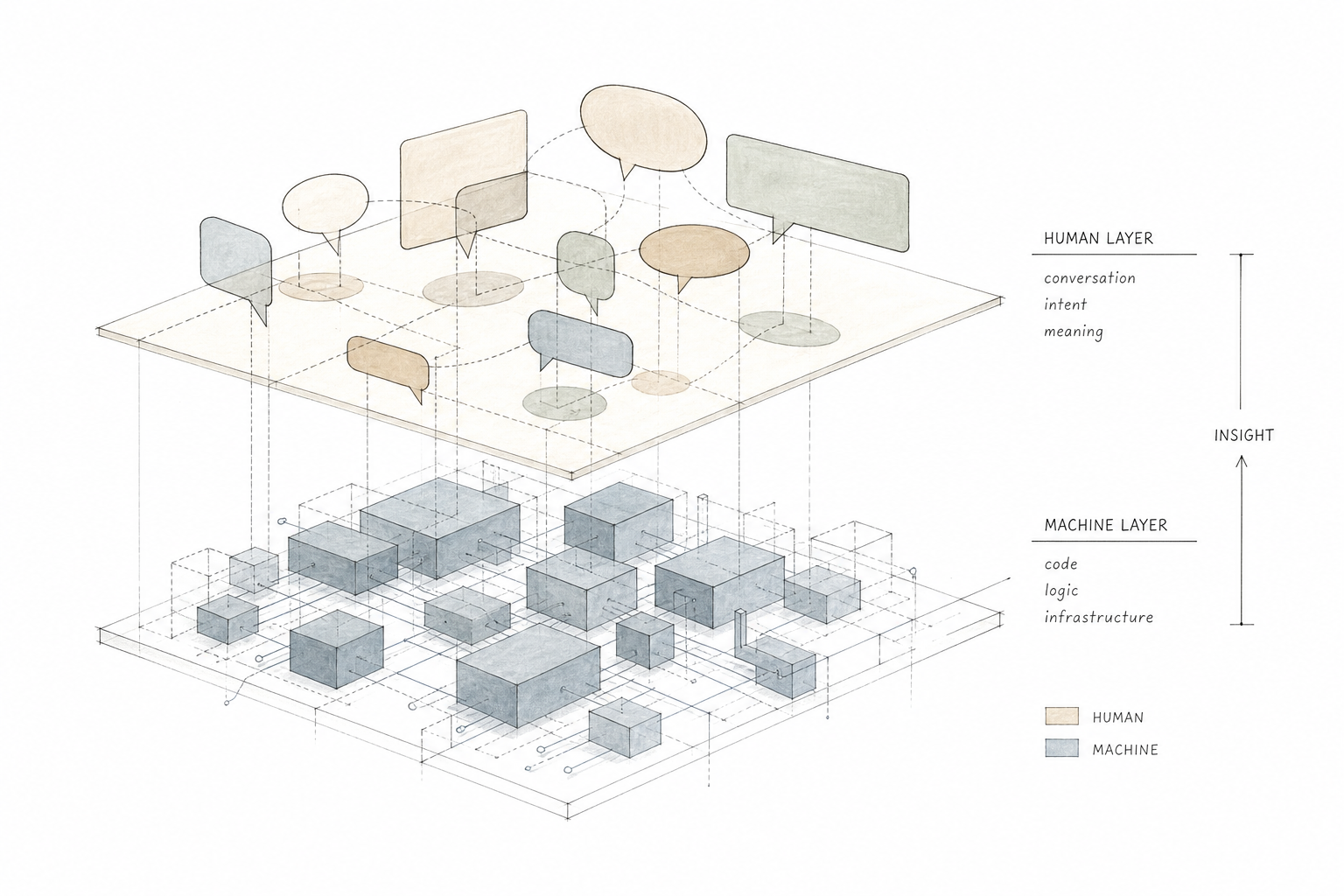
Code does not disappear. It drops a layer—from "how humans operate the system" to "what agents execute and maintain."
The human interface is becoming conversational, not textual-code.
That only works when intent is sharp—see Intent before specific. And conversation alone is not enough: it must produce durable artifacts or intent evaporates. See Chat is a bad system of record. The pattern is language to steer, files to remember—briefs, rules, tests, ADRs as the record of what conversation decided.
Understanding still sits upstream of execution. See Execution is not the bottleneck. The conversational layer is not a shortcut past comprehension. It is comprehension expressed in terms humans naturally use—goals, constraints, trade-offs—not in terms of syntax.
What humans still need
Code may not be for humans to read. It must still be for humans to trust.
Humans are not leaving the loop. They are changing which layer they touch:
- Intent — what the system should optimize for
- Boundaries — what it must never do
- Approval — what ships
- Audit — how a decision can be reconstructed without reading forty thousand lines
Autonomy without structure drifts. See Autonomous systems still need governance and Optimize for alignment, not autonomy.
The goal is not a black box humans cannot question. It is a system humans can steer in language while agents handle the implementation surface—aligned with Let the agent maintain itself: you hold intent and validation; the agent maintains the mechanics.
What replaces code as the human-readable layer
If implementation is primarily for agents, what do humans read?
Not nothing. A different layer:
- Briefs and specs — frozen intent from conversation
- Tests — "this is what we agreed" in executable form
- Rules and playbooks — constraints agents load every run
- Traces and audit logs — what happened, in human terms
- ADRs — why we chose this, not how every line works
The repository may become explicitly layered: conversational artifacts and governance up top, implementation below—maintained by agents, steered by humans. See Living memory for your project for what that memory layer looks like in practice.
Documentation still stabilizes systems—especially agent-maintained ones. See AI systems drift without documentation. The difference: documentation is less often "explain this function" and more often "state what must remain true."
A thought experiment
A team needs a behavior change in production.
Path A: An engineer reads the codebase, finds the module, refactors for clarity, opens a pull request that humans review line by line.
Path B: A human states intent in conversation. An agent proposes the change. The human reviews intent, tests, and a summary of the diff—not every line. The agent maintains implementation.
Which path matches how the system will be operated in three years? Which path still lets a human say no?
We are not claiming Path B wins every time today. We are claiming the default interface may be moving toward B—and that teams still optimizing for Path A may be polishing the wrong layer.
What goes wrong
A few honest failure modes:
- Conversation without record — intent lives in chat and dies in chat
- Trust without audit — humans cannot verify what they never see anywhere
- "Good code" theater — elegant implementation while intent stays vague
- Drift — agents change code; surrounding artifacts do not keep up
- Skill mismatch — hiring for code-reading fluency when the job is system steering
None of these are arguments against the shift. They are arguments for building the layers above code with the same care we once gave to indentation.
Open question
We keep asking whether AI can write good code.
Perhaps we should ask whether code is still how humans are supposed to relate to their systems at all.
Maybe the interface was never the programming language. Maybe it was always language—and we buried it under decades of syntax because implementation was expensive and humans had to be the ones inside the machine.
Maybe AI is not changing how code should look.
Maybe it is changing who code is for—and how humans are meant to reach the systems that run on it.